by Joanne Murphy
- 11 June 2026
Share:
For anyone who has seen (or even glimpsed) the footage of the recent knife attack in Belfast, Northern Ireland (NI) on Monday, there is something truly horror inducing about what happened on that street. It was grotesque — even in the context of a place with a history of unspeakable brutality through 30 years of civil conflict known as “the Troubles.” Of course, far more people will now have seen this awful event — thanks to its dissemination on social media by very many people — including Elon Musk. Musk is a billionaire who never encountered a dangerous situation he couldn’t make worse. His voice and many others, largely from outside NI, have been loud in encouraging protests and mass deportations of “migrants.” A lot of these people seemed to have a sketchy understand of where Belfast is, or the constitutional status of NI as part of the United Kingdom, but not part of Great Britain. As we know very well in this part of the world, you can bring people out on to the street easily, but you can’t control them when they get there. And so it was to be.
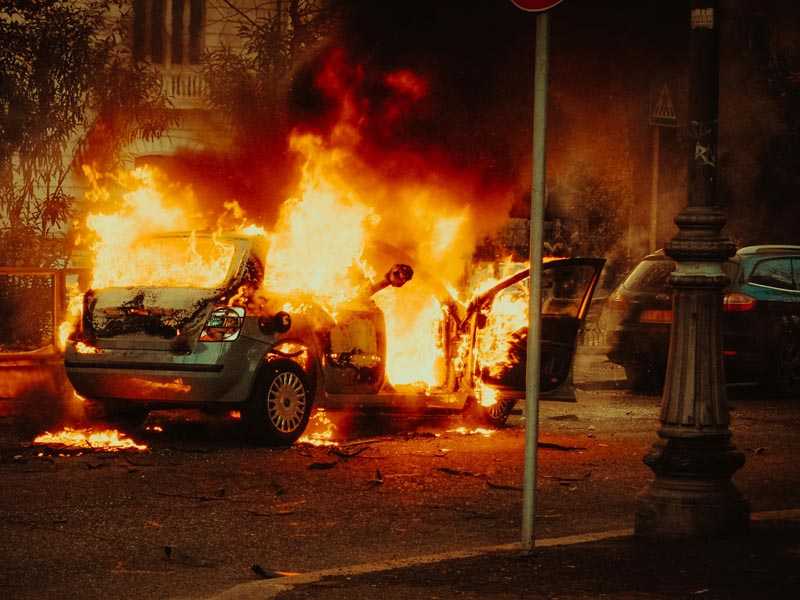
Now we have buses, cars, and even a police vehicle set on fire, people burnt out of their homes because of their ethnicity, crowds of masked men and boys roaming the streets, and the city center shut down — causing not just physical damage and trauma but economic harm at a time when it’s the last thing local businesses need. Ironically, while knife crime is becoming more common in NI, it generally appears in a domestic context. There have been far too many deaths recently where knives were a factor with many being women murdered by their partners or by men controlling and abusing them. It’s profoundly depressing, but as many people have said, there were no riots or demonstrations then.
The attack which has attracted so much attention occurred in North Belfast, a part of the city which is a patchwork of sectarian interfaces, and which has some of the most socially deprived areas in the islands of Ireland and Britain. It used to be known as murder mile, and it’s often said that a third of those who died in “the Troubles” were killed in its streets. Many from outside NI will have only heard of it in relation to a Booker Prize-winning novel published in 2016. Anna Burns’ Milkman was both a literary and commercial success vivid in its portrayal of in-group and out-group division and also oblique in the insidious nature of power and group dynamics. It’s a brutal piece of work but as effective an evocation of a divided society as you can find. The dark leadership of shadowy figures — “community influencers” — who abuse and control form the fabric of the novel. It is these same “community influencers” who are no doubt behind the shameful scenes of violence and destruction in Northern Ireland at the moment. With ties to paramilitarily groups and predominantly loyalist, they hark back to long engagement between Ulster loyalism and the far right.
One of the things that is evident in my work around these environments is the significance of bad actors — those who seek to stoke division for their own aims, particularly during periods of transition and change.
Of course, such violence also represents a failure of leadership at both a community and a political level. I have written recently about the significance of place leadership in fragile and conflicted states and areas emerging from conflict (Murphy & McDowell, 2025). The events of the past few days in Northern Ireland demonstrate how place, space, division, and identity are entwined and also how they are still not yet sufficiently understood. Leadership of place is often regarded in developmental terms with a focus on economic growth. But in societies that are riven by historic divisions and difference and facing rapid demographic change, it is also critical to both the management of violent flares and the building of elusive community cohesion.
One of the things that is evident in my work around these environments is the significance of bad actors — those who seek to stoke division for their own aims, particularly during periods of transition and change. For local leaders the challenge of the management of such actors is a critical component of leadership in politics and on the streets. Obviously, this becomes increasingly difficult when such actors have entire social media platforms at their disposal. It is a tragedy that the type of division which we see in Northern Ireland currently is becoming more prevalent in the world, rather than less. The role of bad actors in such contexts — “influencers,” — locally or digitally, is something we have not yet grasped effectively. It may be one of the emerging leadership challenges of our time.
References
Burns, Anna. 2018 Milkman. Faber and Faber.
Murphy, J., & McDowell, S. (2025). Dilemmas, limitations and challenges of place leadership: instability and transitional dynamics in post-Brexit Northern Ireland. Regional Studies, 59(1). https://doi.org/10.1080/00343404.2025.2490024

Joanne Murphy is Chair of Inclusive Leadership at Birmingham Business School, University of Birmingham. Her research explores leadership, change and organisational development in political volatility, including environments affected by ethno-political conflict. She has worked with a range of organizations including NATO, UNESCO, the John Smith Foundation and the William J. Clinton Leadership Institute. Her fourth book Policing Northern Ireland: Leading through Crisis and Change is due for publication in 2026.