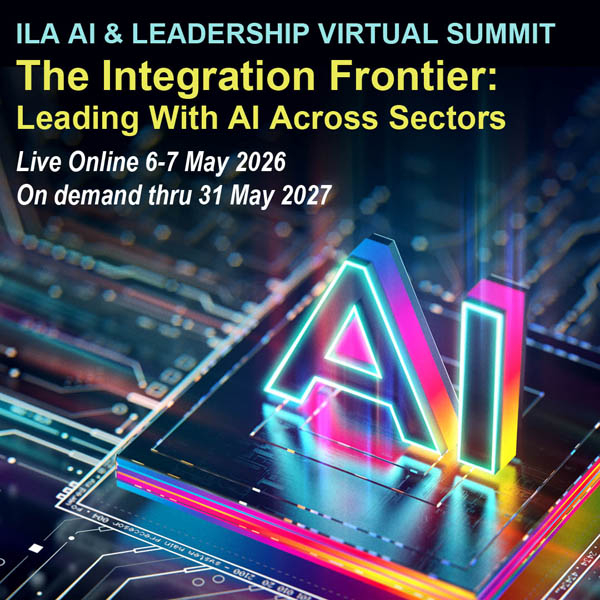
Register Today and Receive Access to the On-Demand Event.
On Demand thru 31 May 2027
Members $50 · Non-members $70
“The 2026 ILA AI & Leadership Summit gave me exactly what I needed as a leader navigating AI today. The summit balanced technical depth with real leadership responsibility. I’m leaving with clearer thinking and concrete steps I can apply right away”
How to Access the On-Demand Event
An email with access instructions went out to all pre-registrants on 1 June. If you did not receive this email, please contact conferences@ilaglobalnetwork.org.
If you registered after that date, access instructions will be in your registration confirmation email.
ABOUT
The 2026 AI & Leadership Virtual Summit brought together researchers, practitioners, educators, executives, and coaches from around the world to wrestle with a question that can’t wait: how do leaders navigate an era when AI is reshaping not just how we work, but how we lead, decide, and define human value?
This year’s theme, The Integration Frontier: Leading With AI Across Sectors, pushed past the adoption conversation to ask harder questions. What does it take to move from AI experimentation to genuine organizational integration? How do leaders maintain human judgment, ethical clarity, and inclusive practice when intelligent systems are embedded in workflows, classrooms, and clinical settings? And what does human flourishing actually look like when the algorithm is in the room?
Across two keynotes and nearly 30 presentations, speakers from organizations including Microsoft, Nava PBC, Otis Worldwide, ESADE Business School, Lyon Business School, and Queen’s University Belfast — alongside independent researchers, coaches, and faculty from institutions across five continents — explored bias and behavioral accountability in AI systems, the knowledge infrastructure AI depends on, peer-led adoption models that advance both inclusion and capability, and what it means to lead teams that increasingly include intelligent systems as participants.
The on-demand package gives you access to all of it, on your schedule, through 31 May 2027.
“The summit created a valuable space to learn from and connect with professionals exploring the rapidly evolving intersection of AI and leadership. I left with new ideas, fresh perspectives, and a stronger understanding of both the opportunities and challenges emerging in this field. I would highly recommend this summit to anyone interested in how AI is shaping leadership, organizations, and the future of work.” — 2026 Attendee
“The Summit was a great way to connect with professionals using AI in some capacity across leadership contexts. It brought theoretical challenges, but practical applications – a true praxis of this work in a rapidly changing environment.” — 2026 Attendee
On-Demand Sessions
Keynotes
Dr Hany Shoukry is a senior technology and transformation executive, executive coach, and researcher whose work sits at the intersection of leadership, systems, and human development.
He brings over 25 years of experience leading large-scale technology, product, and transformation agendas in global organisations, most recently at Sky (Comcast/NBCU), where he operated at enterprise level across multi-market platforms and customer-facing services used by millions. Alongside his executive career, he has spent more than 16 years coaching senior leaders, founders, and individuals navigating complex transitions and high-stakes environments.
Hany holds a PhD in Coaching Psychology and is an Honorary Research Associate at Oxford Brookes University. He is the creator of the Coaching for Emancipation (CFE) framework, which explores how individuals reclaim agency, meaning, and direction within the broader systems they operate in. His work has been published in leading academic and professional outlets, and he is a contributor to global coaching thought leadership, including the International Coaching Federation’s Futures Report.
He is also the recipient of the Coaching for Social Good Award from the Institute of Coaching at Harvard Medical School, recognising his work supporting individuals and communities facing adversity.
Across his work—as an executive, advisor, coach, and writer—Hany focuses on a central question:
how people lead, decide, and remain effective in a world of increasing complexity, pressure, and uncertainty.
He works with senior leaders, founders, and organisations navigating critical transitions—helping them think clearly, act deliberately, and move forward with integrity and impact.
Bias in AI is often treated as a technical issue of data, models, and outputs. Drawing on The Missing B in AI, this session argues that bias is also a behavioural and leadership issue. AI systems learn from behavioural traces, but those traces are partial, contextual, and shaped by incentives, culture, power, and opportunity. Leaders therefore need more than AI literacy; they need behavioural literacy. This session explores how bias enters before, inside, and after the model, and offers a practical behavioural science lens for leading AI systems that support better judgment, accountability, and human agency.
Ganna Pogrebna, PhD, David Trimble Chair in Leadership and Organisational Transformation
Professor Ganna Pogrebna is the inaugural David Trimble Chair in Leadership and Organisational Transformation at Queen’s Business School, Queen’s University Belfast. She is a pioneer in behavioural data science and an interdisciplinary scholar working across artificial intelligence, behavioural science, leadership, decision theory, operations, and cybersecurity. Her work combines data science with economics and psychology to understand human behaviour under risk and uncertainty. Her research focuses on ethical, social, and behavioural dimensions of emerging technologies and their implications for organisations and society.
Ethics, Equity, and Human Flourishing
Addressing the Uncertainty of Shifting Leadership, Economics, & External Support for Artificial Intelligence & Flourishing
Amalfi Gayosso, M.S.I.R.E, MBA
Curtis Isozaki, Executive Coach & Consultant, Isozaki Coaching
Behind the Algorithm: Protecting and Empowering Black Children in an AI World
From digital learning tools to predictive analytics, Artificial Intelligence is influencing how Black children learn and are assessed. Yet, AI can reinforce inequities if left unchecked. This session explores how bias, access, and cultural representation intersect with AI in education. This session focuses on gaining tools to understand, question, and shape how technology impacts families, particularly African American families, through the lens of the 7 Cs of Engagement: Collaboration, communication, care/compassion, culture, connectedness, community, and collective responsibility.
Angela Clark Louque, Professor, Educational Leadership, California State University, San Bernardino
Beyond Efficiency: Reclaiming Authority and Relationality in the Age of AI
AI isn’t just an efficiency upgrade; it’s restructuring authority, judgment, and human agency. This session moves past the hype to examine AI’s impact through critical, intercultural, and ethical lenses. Four perspectives anchor the conversation: redefining core leadership competencies for distributed intelligence; mapping progressive futures of human-AI authority; navigating AI policy through decolonial and feminist lenses; and an Indigenous-partnered case study on relational AI. Theory meets practice throughout.
Stephen Carradini, Ph.D., School of Applied Professional Studies, College of Integrative Sciences and Arts, Arizona State University
Sarina Chugani Molina, Associate Dean and Professor, University of San Diego School of Leadership and Education Sciences
Maike Kugler, Professorin für Personalmanagement, Pforzheim University, Germany
David López, Faculty of Computer Science, Multimedia and Telecommunication, Universitat Oberta de Catalunya (UOC), Spain; Marketing Management, ESADE Business School – Ramon Llull University, Spain
Co-Chair: Antonio Jiménez-Luque, Associate Professor, Leadership Studies, University of San Diego
Co-Chair: Yihe Yang, Assistant Teaching Professor, Organizational Leadership, Arizona State University
Complete Description
- Deconstructing Frameworks: Redefining core competencies in a world of distributed intelligence.
- Critical Pedagogies: Reclaiming human cognitive sovereignty through decolonial and ethical lenses.
- Relational Practice: Designing AI-enhanced environments that foster collective intelligence while preserving the high-touch essence of leadership.
- The Augmented Leader Framework (David Lopez): Moving beyond technical skills, the author will take us to explore the four essential competencies: algorithmic literacy, strategic use, ethical governance, and cultural adoption, which are required for leaders to maintain primary task focus and create value in AI-integrated systems.
- Navigating the Scenarios of Authority (Maike Kugler and Laura S. Aichroth) : The authors will unpack four progressive futures of human-AI interaction. By viewing AI as an evolving partner in role, we examine how these shifts profoundly redefine the dynamics between leadership, followership, and the “silent” presence of the algorithm.
- Leading from the Precipice (Sarina Chugani Molina and V Dozier): Highlighting the crucial role of institutional leaders, the authors discuss navigating AI policy through decolonial and critical feminist lenses. We advocate for an ethics of care and contextually grounded guidelines that resist top-down mandates in favor of systemic health.
- Relational AI and Indigenous Epistemologies (Liliana Caughman, Stephen Carradini, and Claire Lauer): The authors will showcase “RiverBot,” an innovative tool co-developed with Indigenous partners. This case demonstrates AI’s potential to shift from transactional information delivery to fostering relational, ecological connections, honoring diverse ways of knowing in a digital age.
The Human Loop in Action: Navigating AI’s Ethical Frontiers Through Structured Reflection
Speed without wisdom leaves values behind. This hands-on workshop introduces The Human Loop — a five-step reflective framework helping leaders make responsible, human-centered decisions in AI-driven environments. Using a real-world ethical dilemma, participants work through five dimensions: Know Yourself, Know Your People, Know Your Environment, Know Your Impact, and Know Your Self-Awareness. The result: reflection becomes a strategic tool, not a soft skill — and leaders leave with a framework they can use immediately.
Jennifer Sparks Taylor, EdD, Co-Founder The Human Loop, Head of Leadership Development, Director, Center for Effective Organizations, Marshall School of Business, University of Southern California
Elisabeth Graswich, Ed.D., Co-Founder and Author, The Human Loop
Complete Description
The Human Loop in Action: Navigating AI’s Ethical Frontiers Through Structured Reflection
AI is accelerating decisions across every sector, but speed without wisdom can lead leaders across the integration frontier without a compass, leaving people, values, and consequences behind. This 50-minute virtual workshop introduces The Human Loop, a five-step reflective framework designed to help leaders pause, think critically about their thinking, and make responsible, human-centered decisions in AI-enabled environments.
As AI reshapes how organizations operate, leaders increasingly face ethical dilemmas with no easy answers: Whose voices get included in AI-driven decisions? What are the long-term human consequences of choices made at warp speed? How do you align these decisions with your own values and those of your organization?
Through facilitated discussion and guided reflection prompts, participants will explore a real-world AI leadership dilemma using The Human Loop’s five dimensions: Know Yourself, Know Your People, Know Your Environment, Know Your Impact, and Know Your Self-Awareness. This structured approach, grounded in responsible leadership theory and social cognitive theory, transforms reflection from a soft skill into a strategic tool for ethical leadership.
Participants will leave with a practical framework they can apply immediately — individually, with teams, or across their organizations — to navigate the complex terrain where human judgment and artificial intelligence intersect.
This workshop is designed for leaders across sectors — from healthcare and education to business and government — who are committed to ensuring that human judgment, values, and wisdom remain at the center of AI-driven decisions.
Invisible Lenses: Bias, Reflexivity, and Leadership in AI-Mediated Decision Environments
AI doesn’t just assist decisions, it can quietly shape them. This presentation tackles an overlooked leadership risk: losing sight of your own positionality while relying on systems that embed unseen bias. Drawing on research in healthcare leadership, presenters will explore how to surface both external bias in AI systems and internal bias in interpretation. The presentation introduces leaderacy, a leader’s capacity for ethical, bias-aware decision-making in AI-mediated environments.
Erik Bean, Professor of Practice, Indiana Tech, Ph.D. in Global Leadership
Iain Kaan, Doctoral Fellow, Indiana Institute of Technology, Ph.D. in Global Leadership
Complete Descriptions
This session examines a critical but often overlooked leadership challenge: as artificial intelligence increasingly mediates information, leaders risk losing awareness of their own positionality while relying on systems that embed unseen biases.
Drawing on research in bias frameworks and qualitative work on positionality and reflexivity in healthcare leadership, this session introduces a combined approach to evaluating information in AI-influenced environments. Participants will explore how AI can function as a “hidden agenda” source of bias and how leaders can more intentionally surface both external bias in systems and internal bias in interpretation.
The session also introduces the concept of leaderacy, defined as a leader’s capacity to evaluate information, bias, and AI-mediated interpretation for ethical decision-making. Attendees will leave with practical tools to strengthen transparency, credibility, and trust in their leadership practice.
The Oath in the Machine – Patient Input in Healthcare Governance of AI
Bridging AI governance and clinical workflow, I will draw on my experience as both a practicing family medicine physician using ambient AI tools daily and the founder of a clinical AI platform. The workshop will cover how frontline clinical use exposes governance gaps that policy discussions often miss, and why the people closest to patient care need a seat at the table when AI frameworks are being built.
Bhaven Murji, MD, Chief Family Medicine Resident, CEO and Founder of Ignite Health Partnership LLC
Urgency for Global Human Flourishing in the Age of AI
AI’s capacity for transformation is extraordinary, but transformation toward what? This session centers a question too often missing from the AI conversation: human flourishing. Drawing on six domains — happiness, health, meaning, character, relationships, and material stability — participants explore how leaders can shape AI adoption around dignity, purpose, and meaningful work. The session offers frameworks for ethical AI implementation that scale innovation without sacrificing humanity.
Curtis Isozaki, Executive Coach & Consultant, Isozaki Coaching
Complete Description
Education and Academic Integrity
Building AI-Powered Evaluation Systems for Doctoral Dissertation Artifacts
What does AI-assisted doctoral evaluation actually look like in practice? This session pulls back the curtain on a custom AI evaluation system built on Claude’s architecture designed to assess dissertation milestones against 19 criteria and institution-specific rubrics. The result: faster revision cycles, clearer feedback, and stronger scholarly quality without sacrificing rigor. Faculty and academic leaders leave with a replicable model for embedding AI into their own assessment workflows.
Greg Price, MBA, EdD, Professor, Senior Director of Graduate Business Programs, City University of Seattle
Pressley Rankin, Ph.D., Program Director and Professor of Leadership, City University of Seattle
Complete Description
This presentation explores how a business program director designed and deployed custom AI evaluation systems using Claude’s system prompt architecture to assess doctoral-level dissertation artifacts. The artifacts are specifically the Prospectus and Proposal milestones of a Doctor of Business Administration dissertation. Each was engineered with institution-specific rubrics, alignment logic, and structured feedback protocols that mirror committee-level expectations across 19 evaluation criteria and a 10-step assessment process.
The session demonstrates how AI integration directly enhances program director productivity by automating evaluations. Faculty/mentors must still read the documents to ensure the evaluator’s credibility of the assessment. Attendees will see how these systems enforce research rigor by systematically checking alignment across problem statements, purpose, research questions, theoretical frameworks, and methodology. The structured output format improves readability for both faculty and students by translating complex institutional standards into clear, actionable feedback, accelerating revision cycles, and strengthening scholarly quality. Faculty and academic leaders will leave with a practical understanding of how to architect AI-assisted evaluation tools tailored to their own institutional standards, program milestones, and accreditation requirements. Whether managing doctoral committees, coordinating course assessments, or mentoring student researchers, attendees will gain a replicable model for embedding AI into academic workflows without sacrificing intellectual rigor. This is not a passive presentation. Attendees are encouraged to challenge the framework and offer critical feedback, because the best AI systems, like the best scholarship, improve through collaboration.
Educational Integrity & AI: The Faculty Perspective
Academic integrity isn’t just a student issue, it’s taking a toll on faculty. This presentation shares findings from a qualitative study of 413 higher education faculty, surfacing the emotional weight, procedural frustration, and institutional gaps faculty navigate when confronting misconduct. Critically, respondents offered their own strategies for relief. Leaders in education and beyond will leave with practical guidance for better supporting employees struggling to execute their roles in the age of AI.
Jane Forbes, Sociology Faculty, American Public University System
Complete Description
A qualitative content study which examined higher education faculty’s experiences and concerns about academic integrity will be presented. Two qualitative open-ended questions, ‘if applicable, please share a personal experience related to academic integrity/academic misconduct’(Q1) and ‘is there anything further you would like to tell us about academic integrity and academic misconduct’(Q2) had n=413 responses. Resulting themes from tertiary faculty experiences will be presented, including how previous experiences’ influence on future reporting behaviors. Respondents also shared difficulties with how to confront students, how to process suspected violations, the emotional toll it takes on them, increased workload to process issues, and frustration with lack of institutional accountability. The presentation will share respondents’ own suggested strategies for alleviating the negative impacts they experienced. Attendees will come away with guidance for how leaders in education and other organizations can improve their relationships with employees who are struggling with understanding how to effectively execute their roles in the age of artificial intelligence.
ETHOS Framework for AI Literacy & Implementation
Billions are flowing into AI, yet 95% of pilots report zero ROI. The gap isn’t technical — it’s leadership. This session introduces the ETHOS Framework — Ethics, Transparency, Humanity, Openness, and Stakeholders — a values-driven model for sustainable AI adoption drawn from research on globally recognized nonprofits. Participants leave with practical strategies for building AI literacy, creating coalitions, and cultivating organizational humility: the capacity to sit with uncertainty and still lead with purpose.
Kathleen Scott, Postdoctoral Fellow, Pepperdine Excellence Postdoctoral Project for Equity Research (PEPPER), Pepperdine University; Consultant @ Cisco, Microsoft, Amazon, and others
Complete Description
Organizations are investing billions in AI while 95% report zero ROI from their pilots (MIT Media Lab, 2025). The problem isn’t the technology, it’s the leadership gap. This session builds on the AI Leadership Competencies framework presented at ILA’s 2025 Global Conference to introduce the ETHOS Framework: a values-driven model for ethical, sustainable AI adoption that keeps humans and missions at the center.
Drawing from the presenter’s research examining how globally recognized nonprofits navigate AI integration, this talk identifies why even well-resourced organizations struggle with implementation. The answer lies in five interconnected principles: Ethics (embedding values in technological decisions), Transparency (building trust through open communication), Humanity (centering human dignity and agency), Openness (cultivating organizational humility and learning), and Stakeholders (engaging those affected by AI systems). The ETHOS Framework positions AI adoption as an ongoing exercise in organizational learning and ethical deliberation where leaders learn to ask better questions.
Participants will leave with practical strategies for developing AI literacy that go beyond understanding tools to understanding impact, building coalitions across organizational hierarchies, and creating cultures of “organizational humility” where admitting uncertainty becomes strength rather than weakness. The session demonstrates that sustainable AI transformation requires leaders who can balance technical possibility with institutional purpose by amplifying human capability.
Reading Didn’t Break in College: What Higher Ed Leaders Need to Know About the Literacy Gap AI Can’t Fix
Higher education leaders are watching students arrive underprepared for academic reading and writing, and reaching for AI tools as the solution. I’ll make the case that AI is amplifying the problem rather than solving it, and share what structured, multisensory literacy approaches look like for adult learners, including the belief and agency layer that no technology can address.
Linda Colasanti, Founder, Reading For All™
Panelists
Dan Jenkins, PhD, Co-Chair, ILA AI & Leadership Virtual Summit; Professor of Leadership & Organizational Studies, University of Southern Maine
Mary Tabata, Ph.D., Co-Chair ILA AI & Leadership Virtual Summit; Adjunct Faculty and AI Concentration Lead, Eastern University College of Business & Leadership
Kevin Bottomley, Ph.D., Assistant Professor, PhD in Global Leadership Program, Indiana Tech
Leadership Mindset and Capability
5 Supportive Constructs for Leadership’s AI Journey
Education is at a defining moment — and its leaders may not be ready. This session shares findings from a global mixed-methods study spanning 25 countries and every level of K-20 public education, examining how educational leaders understand AI’s role in advancing lifelong learning, equity, and systemic change. The results surface critical gaps in expertise and offer broad recommendations with relevance well beyond the education sector.
Deb Homuth B.A. B.Ed. M.Ed. E.D.D., Director of Curriculum and Instruction, Enya Learning, Canada
Complete Description
Education stands at the precipice of the most significant moment in the history of its leadership. This session will share the results of a mixed methods research study which set out to uncover the perspectives and experiences of educational leaders globally who work at different levels of K-20 education in publicly funded systems to try to understand if these leaders understand what is meant by a new global agenda for education focused on the realization of lifelong learning for all, whether they see themselves as responsible for co-designing the use of AI in education to help realize that mandate, and whether they see how they might use their positions of soft power and influence to shape change for the greater good.
The main questions of this research study were:
- What do educational leaders K-20 see as the benefits/risks, opportunities/challenges of AI as a means for achieving greater equity for all in the pursuit of lifelong learning?
- What is the current level of expertise of educational leaders K-20 with respect to AI and what training/education is needed to implement AI in support of lifelong learning for all?
- How will specific supports help educational leaders K-20 to realize this universal mandate for change?
The interview participants came from 25 different countries. A broad series of recommendations for how leaders can be supported in this unique moment in time were identified in this study. This study of leadership’s approach to AI has much applicability to leaders in many sectors.
Complexity of AI Leadership & Roles
AI is reshaping global leadership roles — and the results so far have been mixed. As humans and machines increasingly collaborate, trust has become a critical leadership currency. This session synthesizes existing research on leadership competencies to identify what it actually takes to lead responsible AI adoption. The goal: move the conversation on leadership development from speculation to evidence, equipping leaders with the competencies that matter most in an AI-driven world.
Katja Schroeder, Global Leadership Communications Consultant; Ph.D. student, Global Leadership, Troy University
Complete Description
The rise of artificial intelligence (AI) platforms and tools is increasing the complexity of the global leadership context and roles. AI is transforming operations, stakeholder engagement models, and entire work environments in organizations, creating both opportunities and challenges for global leaders as they navigate their teams to an AI-driven business environment. To date, AI implementations in organizations have achieved mixed results and establishing trust has become more important in an organizational environment in which humans and machines collaborate. The session will present a summary and analysis of existing studies on leadership competencies to lead organizations in the age of AI. The presentation aims to contribute to the discussion on leadership development, and which leadership competencies are critical to responsibly lead AI adoption processes.
Developing Wisdom for AI Integration
AI is not one thing — it’s many, combining in ways that compound complexity faster than any leader can navigate alone. Meeting that challenge requires collective intelligence. This interactive session harnesses the wisdom in the room, inviting participants to share micro-narratives of their own AI integration experiences. Structured reflection and AI-assisted synthesis then transform that collective experience into actionable insights for leading through local challenges — together.
Jonathan Reams, Chief Creative Officer, Center for Transformative Leadership
Wayne Buckhanan, Leadership Practicum Coach; Associate Professor of Engineering, School of Leadership, Andrews University
Complete Description
AI is changing our world faster than we can keep up. While using AI can open new possibilities, it can also lead us astray. As the landscape evolves, it becomes clearer that AI is not just one thing, it is many things all at once, combining in new ways with itself that increase the complexity of challenges more than ever.
Our challenge is to develop sufficient wisdom, knowledge and ethics to lead with AI rather than be led by it. This is not possible as a solo effort. It requires collective intelligence, informed by collective awareness of collective experience.
Traditional methods for such collective work are constrained by limitations of time, process and resources. Introducing AI into this work can enable distributed leadership to take collectively informed local action.
This interactive session will briefly frame such challenges to set the context for participants to share micro-narratives of their own experience of integrating AI into processes, followed by some simple structured reflections. We will then use AI to gain awareness of how perspectives from participants’ collective experience can inform developing actions for leading in our own local challenges.
Human Intelligence in the Growing Era of Artificial Intelligence: A Leadership Imperative
As AI becomes embedded in organizational life, the differentiator isn’t artificial intelligence — it’s human intelligence. Today’s workforce carries new psychological expectations from its leaders: more empathy, more presence, more intentionality. This session examines shifting workplace dynamics and makes the case that a distinctly human leadership approach isn’t just good practice — it’s a competitive advantage.
Edwin Mouriño, Ph.D. Adjunct Professor; President and Founder, Human Intelligent(HI)Workplace
Complete Description
In the growing era of AI, organizations are going to need leaders that demonstrate HI (human intelligence). This workshop will highlight how today’s trends, including the changing workforce psychology is going to need an increased human touch and focus from its leaders. This session will address these changing workforce and workplace issues and how effective leadership will be key to give organizations a competitive edge. Today’s workforce has different expectations from its leaders. This session will address these issues with recommendations.
Leveraging Ai in Symbolic Exploration of Organizational Relationships & Stakeholders
Navigating complex organizational change means knowing who holds power, legitimacy, and urgency — and how to engage them strategically. This session explores how AI can serve as a thought partner in stakeholder mapping, helping leaders prioritize relationships, surface latent influences, and build supportive coalitions. Drawing on the stakeholder salience model in academic settings, participants will audit their most important stakeholders and apply relational coordination strategies to drive meaningful, inclusive change.
Dave Houglum, Ph.D., CPCC, PCC, Director of Leadership Studies and Leadership Professor of Practice, University of Portland
David Fuentes, EdD, PharmD, MSOL, SHRM-CP, Professor, College of Health, University of Montana
Complete Description
The stakeholder salience model applies to academic settings where cross-departmental, multidisciplinary, and complex infrastructures govern the management of change. The stakeholder salience model, applied in business and leadership, can be leveraged to engage stakeholders, given the shared governance models. Using a text-rich Ai application as a thought partner can enhance our approaches to include stakeholders in change management initiatives.
Stakeholders, with different levels of power, legitimacy, and urgency, can have a strong impact on curricular innovations, policy-driven decisions, student support services, and more. Academia is ripe with decisions requiring stakeholder input, including adopting new teaching modalities, implementing new degree requirements, proposing new programs of study, appointing leaders, or deciding committee composition. Ai can help leaders prioritize stakeholder interests, relationship depth, and evolving industry-specific interests.
Leaders at all levels can benefit from this session, as it encourages auditing our most important stakeholders and applying relational coordination to engage our widest audiences, and ensure that the appropriate strategies are observed in building supportive coalitions. Applications will also feature authentic situations where important stakeholders may have a latent impact on our efforts and initiatives, requiring thoughtfulness and intentionality when crafting plans for leadership change.
Mitchell, K., Agle, R., & Wood, D. (1997). Toward a Theory of Stakeholder Identification and Salience: Defining the Principle of Who and What Really Counts. Academy of Management Review, 22, 853-886.
Why How You Think Matters More Than What You Know in the Age of Artificial Intelligence
AI is reshaping leadership in ways we’ve never seen. Today’s leaders face a dual pressure: maximize AI-driven productivity while staying deeply human. They’re managing hybrid teams of people and AI agents, navigating skills gaps, and confronting rapid change—all at once. Success requires real mindset shifts in humility, communication, adaptability, and emotional intelligence. This session explores those shifts and includes a hands-on exercise to bring them to life.
Jim Barge, Visiting Asst. Professor of Management and Leadership, School of Business and Communication, Mount St. Joseph University
Complete Description
Geoff Woods (2024) offered that “the difference between AI’s impact being net positive or negative lies not in the technology itself but in the leaders using it” (p. 25). Artificial intelligence, in all its forms and definitions, is a technology game changer unlike any we have seen in the last 60 years. The massive investment and growing adoption of AI tools by industry is presenting new and unique challenges to leaders, as they grapple with not only what to deploy and how to deploy it for the highest productivity gain, but equally important, they must adjust leadership approaches and mindsets. They are being buffeted by two opposing forces—that of the need to demonstrate that they can apply AI for maximum efficiency and productivity on one side and the need to demonstrate they are pro-human and have toe ability to navigate their team through these massive changes. For example, they may be leading a team of humans and AI agents, where the AI agents are smarter on many things but dumb as rocks on others and work 24/7. Further as AI is adopted, the skills gap between those who embrace the AI change and those that do not, will grow and become problematic. These significant changes require mindset shifts in many areas of leadership, including humility, communication, adaptability and emotional intelligence that can equip leaders to successfully navigate AI adoption and use. I will review these mindset shifts and engage the audience in a simple exercise to illustrate my case.
Organizational Implementation and ROI
AI as Team Member
AI is evolving from tool to teammate — and leadership practice hasn’t caught up. This conversational session looks beyond productivity and automation to ask a harder question: how do you lead a team that includes intelligent systems? Through open dialogue, participants will explore what human-AI collaboration could look like, what capabilities humans need to develop, and what ethical and organizational questions leaders should be wrestling with now — before the future arrives.
Kimberly Carlson, Ph.D., Co-Founder & CEO, Tractus Strategic Partners, LLC
Charity Boyette, Ph.D., Co-Founder & COO, Tractus Strategic Partners, LLC
Complete Description
Artificial intelligence is rapidly moving from tool to collaborator. Much of today’s discussion focuses on productivity, automation, and AI literacy. Yet a deeper leadership question is beginning to emerge: what happens when AI systems function less like software and more like members of the team?
Many technologists suggest that increasingly capable forms of AI may emerge within the next several years. If that occurs, organizations may find themselves working alongside AI systems that contribute ideas, analyze complex information, and participate in decision processes in ways that resemble human collaborators. While organizations are actively experimenting with AI tools, leadership and management practices have barely begun to explore what it would mean to manage teams that include intelligent systems.
This session invites participants into an open dialogue about preparing for a future in which humans and AI work as integrated teams. Together we will explore questions such as:
- What might it mean for AI to function as a full participant in organizational work
- How might leadership and management practices change when some “team members” are intelligent systems
- What capabilities should humans develop to complement AI strengths rather than compete with them
- How might managers design teams, workflows, and decision processes that integrate human judgment and AI insight?
- What ethical, relational, and organizational questions should leaders begin considering now?
Rather than focusing on tools or technical skills, this conversation looks ahead to the emerging challenge of leading human–AI teams. Participants will share perspectives, experiences, and open questions about how leadership education, management training, and organizational design may need to evolve as AI becomes embedded in everyday work.
From AI Adoption to AI Integration: Preventing Organizational Drift in the Integration Frontier
Adopting AI is one thing — integrating it is another. Many organizations are stuck in adoption mode, resulting in fragmented implementation and innovation that drifts from mission. This session presents a leadership systems framework for true AI integration, drawing on cross-sector experience in education and leadership development. Participants leave with a practical model for anchoring AI in mission, establishing human oversight, redefining leadership competencies, and measuring impact beyond productivity.
Nathan Hamblin, Dean of the School of Leadership at University of the Cumberlands
Complete Descriptions
AI has moved from experimentation to embedded infrastructure. Yet many organizations remain in adoption mode rather than integration. The result is drift: fragmented implementation, efficiency without coherence, and innovation misaligned with mission.
This presentation advances a leadership systems framework for AI integration. Drawing on cross-sector implementation in education and leadership development contexts, the session reframes integration as a governance and capability challenge rather than a technical initiative.
The model integrates adaptive leadership, systems thinking, and responsible AI design to outline how leaders can:
1. Anchor AI use in mission clarity
2. Establish human-in-the-loop guardrails
3. Redefine leadership competencies in AI-augmented environments
4. Evaluate impact beyond productivity metrics
Participants will leave with a transferable integration framework and evaluative lens applicable across sectors.
Frontier Organization Development: Scaling Transformation Through Agentic AI and Capability Building
What happens when an Organization Development Center of Excellence deploys agentic AI, not to replace OD practice, but to scale it? This session shares how one OD CoE extended its reach enterprise-wide by embedding intelligent, guided tools into diagnostics, change strategy, and team effectiveness while simultaneously building OD fluency across HR Business Partners. The result: a distributed, scalable transformation model with real outcomes and a practical blueprint others can follow.
Omar Morales, Head of Organization Development, Microsoft
Complete Descriptions
Leaders as Systems Architects for AI Agents
AI isn’t just a tool anymore — it’s an agent that executes. This shift demands a new kind of leader: the System Architect of Agents. This session explores what it means to move from managing human output to orchestrating autonomous AI workflows, redesigning how work gets designed rather than just done. Participants will learn frameworks for leading through the agentic frontier while keeping human judgment at the center of intent, ethics, and systemic integrity.
Joe Oakhart, Principal Software Engineer, Nava PBC
Complete Description
The transition from “AI as a tool” to “AI as an agent” represents the most significant shift in leadership since the dawn of the internet. We are moving beyond simple prompting toward the orchestration of autonomous agentic workflows—systems that don’t just assist, but execute. For leaders, this requires a fundamental evolution in capability: moving from managing human output to becoming a “System Architect of Agents.”
In this session, we will explore the evolution of the Principal Lead role. We will discuss how to move teams away from manual task execution and toward designing the high-level skills, hooks, and orchestration patterns that allow AI agents to solve complex, systemic problems. This is not just a productivity play; it is a redefinition of technical and organizational leadership. Participants will learn how to lead multidisciplinary teams through the “Agentic Frontier,” focusing on building frameworks that continue to work for the organization long after the initial design. We will examine the shift from “doing the work” to “designing the work,” ensuring that as AI takes on more autonomy, human leadership remains the vital architect of intent, ethics, and systemic integrity.
Paying Down Knowledge Debt: What Professional Services Organizations Must Fix Before AI Can Help
AI didn’t create your knowledge management problem — it just made it impossible to ignore. For professional services firms, decades of tribal knowledge, orphaned docs, and siloed information mean AI tools retrieve wrong answers or nothing useful at all. This session offers a practical framework for diagnosing and fixing knowledge infrastructure: from building authoritative sources of truth to shifting team culture so documentation becomes an asset, not a chore.
Ryn Bennett, Knowledge Systems Architect & AI Operations Lead, Nava PBC
Complete Description
Most professional services firms have a decade of institutional knowledge scattered across drives, inboxes, and the heads of people who might leave next quarter. AI exposes this problem.
Digital modernization firms, consultancies, and complex delivery organizations are discovering that AI adoption surfaces a problem that predates AI: their knowledge is unstructured, inconsistent, undocumented, and siloed. The result is AI that confidently retrieves the wrong answer, or nothing useful at all.
This talk offers a practitioner’s framework for diagnosing and paying down knowledge management technical debt in professional services contexts, drawing on hands-on experience redesigning knowledge infrastructure across a large portfolio of active delivery engagements. Ryn will cover:
- What KM technical debt actually looks like in services organizations. Tribal knowledge, orphaned documentation, inconsistent taxonomy, and the project handoff problem that compounds with every new engagement
- Why AI readiness is a knowledge architecture problem first, and how to assess whether your organization’s knowledge is structured well enough for AI to retrieve anything trustworthy
- The canonical source question: how to define, build, and maintain authoritative sources of truth in environments where the work is always changing and the people rotate
- Human-in-the-loop as operational discipline: designing review and maintenance workflows that keep knowledge current without creating unsustainable overhead for practitioners
- Change management for knowledge work: how to shift delivery teams from treating documentation as a compliance burden to treating it as infrastructure, and why that cultural shift is the actual prerequisite for AI value
This session is for leaders in professional and delivery services who have invested in AI tooling and are not seeing the returns, and who are ready to look upstream at the knowledge foundations those tools depend on.
Peer-Led AI Adoption: How Business Resource Groups Are Building AI Capability and Confidence at Otis
How do you build genuine AI confidence across a global workforce? Otis Worldwide found an answer in an unexpected place: their Business Resource Groups. This case study shows how BRGs drove AI adoption through peer-led learning sessions and hands-on Copilot workshops — advancing both inclusion and business goals simultaneously. The result: measurably increased employee confidence in AI tools and a replicable model for organizations seeking inclusive approaches to AI readiness.
Karen Perham-Lippman, Senior Manager, Global Inclusion & Belonging, Otis Worldwide Corporation
Complete Description
AI adoption and increased employee confidence. Otis Worldwide Corporation is the world’s leading manufacturer, installer, and servicer of vertical transportation systems, primarily elevators, escalators, and moving walkways. This presentation will share best practices from our global Business Resource Group (BRG) program and will highlight how our BRGs contribute to colleagues’ AI adoption and skill-building, supporting both our company’s inclusion and broader business goals. Examples will include BRGs contributing to AI learning sessions from the field and BRG led Tech Talks on Microsoft Copilot, which give colleagues hands-on experience and practical skills. Outcomes include increased employee confidence in use of AI tools through implementation. This case study may offer replicable strategies for any organization seeking inclusive approaches to AI readiness in the workplace.
Scaling AI Without the Hype: What Works in Higher Education Systems
Moving AI from pilot to institution-wide impact is harder than it looks. Drawing on experience leading finance and strategic AI integration across a complex university system, this session cuts through the hype to focus on what actually works: governance structures, cross-functional collaboration, and disciplined execution. Participants leave with a clearer picture of where AI delivers real value, what pitfalls to avoid, and how to scale responsibly without adding unnecessary complexity or risk.
Ryan Low, Vice Chancellor for Finance and Strategic AI Integration, Maine’s Public Universities – University of Maine System
Complete Description
Scaling AI Without the Hype: What Works in Higher Education Systems
As artificial intelligence moves from experimentation to expectation, higher education leaders face a critical challenge: how to scale AI in ways that are practical, sustainable, and aligned with institutional priorities. This session explores what it actually takes to move beyond pilots and isolated initiatives toward systemwide impact.
Drawing on experience leading finance and strategic AI integration across a complex university system, this talk will highlight how AI can enhance operational efficiency, support better decision-making, and unlock economies of scale—without adding unnecessary complexity or risk. Attendees will gain insight into the governance structures, cross-functional collaboration, and disciplined execution required to make AI work across institutions.
Rather than focusing on emerging tools alone, this session emphasizes integration—how AI connects with existing systems, processes, and people. Participants will leave with a clearer understanding of where AI delivers real value, what common pitfalls to avoid, and how to lead implementation efforts that are both innovative and grounded in organizational realities.
Tackling ROI failure in AI Implementation
Companies are pouring resources into AI — and many have little to show for it. Pilots stall, tools go unused, and promising experiments never scale. The technology usually isn’t the problem. This session examines why AI initiatives so often fail to deliver ROI and what it actually takes to move from experimentation to lasting value: aligning strategy, culture, and technology so they reinforce rather than undermine each other.
Adam Breen, Founder & President, elements.biz; Entrepreneurship and Innovation, EM Lyon Business School
Complete Description
Artificial Intelligence is now central to corporate strategy. Companies are investing heavily in AI tools and initiatives, expecting productivity gains, better decisions, and new sources of value.
Yet a clear pattern is emerging: many AI initiatives fail to deliver measurable return on investment.
Projects stall after the pilot phase. Tools are deployed but rarely used. Promising experiments fail to translate into operational impact.
The problem is rarely the technology itself.
Successful AI implementation depends on aligning strategy, culture, and technology. When these forces move out of balance, even powerful AI solutions struggle to create real business value.
This presentation explores why AI initiatives often fail to generate ROI—and how organizations can rethink their approach to move from experimentation to sustained value creation.
Coaching and Cross-Sector Perspectives
Experts across industries and continents will discuss how AI is shaping markets and industries globally.
Nelson Granados, Pepperdine Graziadio Business School, Academic Director of the Doctorate in Business Administration, Executive Director of the Institute for Entertainment, Media, and Sports
Benedict Juliano, Knowledge Manager, Indra Philippines Inc.
Daniel Tembinkosi Semwayo, Ph.D., Senior Consultant, Ontolligent; Southern Africa Liaison, W.K. Kellogg Foundation Global Fellows Network
Pamayla Darbyshire, Post Doctoral Researcher, author, mentor, peer reviewer
Emerging Power of Artificial Intelligence (AI) in the Intersections of Business, Education, and Coaching
AI is reshaping business, education, and coaching but who is shaping AI? This panel examines three interconnected dimensions: the underrepresented history of women in the field and the imperative for inclusive AI authorship; the concept of “leaderacy” and how leaders navigate algorithmic and internal bias; and the shift from AI-assisted to AI-enabled coaching. Together, panelists offer a roadmap for moving from passive users to strategic architects of human potential.
Erik Bean, Professor of Practice, Ph.D. in Global Leadership, Indiana Tech
Joanne Vázquez de Príncipe, Founder & CEO, Purposeful Advising and Coaching; Doctoral Associate Faculty of Organizational Behavior, University of Phoenix
Simone Arnold, Author, Editor, Professor, Public Speaker and Product Leader.
Moderator: Mary Tabata, Ph.D., Co-Chair ILA AI & Leadership Virtual Summit; Adjunct Faculty and AI Concentration Lead, Eastern University College of Business & Leadership
Complete Description
A Foresight Driven and AI Powered Enterprise Modeling Framework
When complexity, polarization, and uncertainty converge, traditional decision-making frameworks break down. This session introduces an AI-driven enterprise modeling framework — grounded in complex systems theory and built on principles of ontology engineering, causality, explainability, and transparency — that helps leaders rapidly explore scenarios, assess risk, and reconcile competing perspectives. The goal: move AI beyond automation toward genuine augmentation, reshaping leadership capability for environments where the signals are weak, uncertainty is rife, and the stakes are high.
Daniel Tembinkosi Semwayo, Ph.D., Senior Consultant, Ontolligent; Southern Africa Liaison, W.K. Kellogg Foundation Global Fellows Network
Complete Descriptions
In an era defined by accelerating change and deepening polarization of perspectives, traditional dialectical models—where thesis and antithesis converge toward synthesis—are increasingly insufficient for navigating complexity. Leaders today must operate in environments characterized by uncertainty, emergent dynamics, weak signals, and competing stakeholder worldviews.
The presentation introduces a novel AI model and enterprise modeling framework, recently published as a PhD thesis, that incorporates complex systems concepts in advanced artificial intelligence (AI) modells and machine learning (ML) algorithms. The framework applies causality, explainability and interpretability principles to support transparent, accountable, and context-aware decision support, enabling sense-making in conditions where complexity, ambiguity, and polarization often paralyze traditional decision-making processes.
By combining complex systems-based enterprise modeling with AI-driven simulation capabilities, leaders can rapidly explore and compare multiple future scenarios, assess underlying drivers of change, and test strategic responses across divergent stakeholder perspectives on the fly, using available and fast changing data to make informed decisions.
The presentation will explore how the AI-informed systems modeling framework can support leaders to:
- Navigate complexity across public, private, and nonprofit domains;
- Manage systemic risk management in volatile and uncertain environments;
- Identify cross-sector opportunities for innovation and collaboration amid disruptive technological and socio-economic shifts;
- Facilitate semantic reconciliation across disciplines, sectors, and polarized perspectives;
- Discover new knowledge within complex adaptive systems;
- Integrate distributed knowledge into coherent, actionable insights.
The presentation aims to stimulate dialogue on how systems-informed AI can move beyond automation toward augmentation—reshaping leadership capabilities for resilient, adaptive, and inclusive futures.
Members $50 · Non-members $70
Invitation to Attend
Drs. Mary Tabata and Dan Jenkins, Co-Chairs of ILA’s 2026 AI & Leadership Virtual Summit, share more about the summit and why they’re excited for this year’s program.
SPEAKERS














































SPEAKER BIOS
Erik Bean is a professor of practice in the Ph.D. in Global Leadership program at Indiana Tech. His research explores media literacy, artificial intelligence, and ethical leadership. He has published in the Journal of Leadership Studies and Media Literacy and Academic Research on AI, bias, and information credibility. Dr. Bean is the author of Bias Is All Around You and serves as Michigan Chapter Leader for Media Literacy Now, engaging public audiences through workshops on media literacy and ethical AI.
Ryn Bennett, MPH is a knowledge systems architect and AI operations leader specializing in high-trust, regulated environments. As Senior Manager of Delivery Operations at Nava PBC, they design AI-enabled knowledge infrastructure that transforms fragmented institutional data into scalable, governed systems. Creator of the APPE certification — the first AI credential for proposal professionals — Ryn is a Lean Six Sigma Green Belt, 2x 40 Under 40 honoree, world-record athlete, and TEDx speaker.
Dr. Kevin Bottomley serves as Assistant Professor, PhD in Global Leadership Program, Indiana Tech. He has obtained the following AI-related training and certifications: AI Governance, PrivacyOps, AI Ethics, ACUE Empowering Students to Use AI Responsibly, ACUE Writing Effective AI Prompts, ACUE Teaching with AI-Centered and AI-Resistant Learning Experiences, and ACUE Leveraging AI to Develop Course Resources. Additionally, he has worked with doctoral students on dissertation committees in the AI/ML and VLE space. Dr. Bottomley was a panelist at the ILA conference in Vancouver, CA, with the topic AI, Leadership, and Ethics; he has published and presented at other national and international conferences.
Charity Boyette (Ph.D.), Chief Operating Officer, has more than two and a half decades of experience in managing teams and programs, with a particular focus in team leadership, engagement, and development. Currently, she is an Assistant Professor of Practice in Management at Virginia Tech. From 2009-2018, she was a tenured Foreign Service Officer with the U.S. Department of State who served overseas tours in Nigeria, Poland, and Belgium, as well as assignments in Washington, DC, including two years on Secretary of State Kerry’s travel team. Prior to her federal service, Charity worked in leadership development, operations, and finance in the U.S. defense industry. She holds a Ph.D. with a focus on public-sector workforce engagement and development from the Center for Public Administration and Policy at Virginia Tech. She earned her MBA, with a focus in strategic development, from the Mason School of Business at the College of William & Mary and a bachelor’s degree in business administration from Averett University in Virginia.
Kimberly Carlson (Ph.D.), Chief Executive Officer, has over 20 years of experience in nonprofit leadership, board development, strategic planning, and project management. Currently, she serves as co-founder and CEO of Tractus Strategic Partners. Previously, she was the Director of Volunteer Advisory Board Strategy at Virginia Tech, where she acted as an internal consultant supporting the strategic alignment and collaboration of leadership volunteers across the institution. She maintains an academic and research affiliation with Virginia Tech as a faculty affiliate with the Center for Educational Networks and Impacts in the Institute for Creativity, Arts, and Technology, as well as an Associate Professor of Practice in the Management Department in the Pamplin College of Business. She holds a Ph.D. in Public Administration/Public Affairs from Virginia Tech with a specialization in nonprofit management and organizational leadership, an M.S.W. in Clinical Social Work with a certificate in Arts and Community Practice from Florida State University, and undergraduate degrees in Psychology and Theatre Arts with a minor in Sociology from Virginia Tech.
Linda Colasanti is the Founder of Reading For All™ and a Certified AI Consultant with 15+ years as a Dyslexia Specialist and Orton-Gillingham Practitioner. She holds nine certifications across structured literacy, NLP, and AI implementation. Linda built the Reading For All™ structured literacy curriculum and uses AI to deliver it as an interactive, multisensory learning system. A former State Director of Decoding Dyslexia NC and legislative architect of NC’s first dyslexia law, she brings rare expertise at the intersection of how humans learn and how AI can serve that process without replacing it.
Dr. Pamayla E. Darbyshire is an alum of the College of Doctoral Studies, University of Phoenix, where she earned her doctorate in health administration. Dr. Darbyshire is a fellow with the Center for Educational and Instructional Technology Research (CEITR). She is a long-time Sigma Theta Tau International Honour Society of Nursing member. In addition, Dr. Darbyshire is a member of the Association of peri-Operative Registered Nurses (AORN) National Research Committee. She has co-authored for The AORN Journal, Phoenix Scholar, and other peer-reviewed journals. She is a member of the Case Management Society of America (CMSA) and plays a pivotal role in one of its core committees, tasked with developing the committee’s mission, vision, and official statement. Dr. Darbyshire’s commitment to the academic community is evident in her role as a mentor for College of Doctoral Studies students (UoPx) and the ANA mentor/mentee committee. Her research interests include case management, chronic diseases, neurodiversity, and the application of artificial intelligence in higher education. She has presented at numerous virtual conferences with an international audience. Dr. Darbyshire has been a registered nurse for over 45 years, engaged in all aspects of patient care, from Med-Surg to critical care and the operating room, ending her career with the USAF, NC, as an educator and leader.
Dr. Jane K. Forbes is an internationally recognized Sociologist. She holds a doctorate in Education Leadership and is faculty at the American Public University System and Park University. Her research spans academic integrity, education, organizations, peace and conflict studies, and the workplace. Her recent study on faculty experiences with academic integrity in the age of AI found that faculty desire technology to detect AI in student submissions and that it’s an emotionally charged issue.
David Fuentes, EdD, PharmD, MSOL, SHRM-CP, has served as a faculty member and administrator across several disciplines in healthcare education. He has worked within interprofessional frameworks in teaching, service, and scholarship. His experiences as an administrator have provided him with the opportunity to engage in work related to academic operations, accreditation, assessment, curriculum redesign, faculty development, leadership training, student support services, and teaching effectiveness. He has earned certifications in Gallup leadership coaching for strengths, lean systems, human resources, and team-based learning. A lifelong learner, academic, and pharmacist by training, he has also earned degrees in organizational leadership and organizational psychology through his master’s and doctoral work in higher education leadership. He currently serves as associate dean and professor for the College of Health at the University of Montana.
Amalfi Gayosso is a scholar-practitioner in ethical leadership and sustainable development whose work examines how values-driven frameworks guide organizational change and responsible real estate development. Her research focuses on systems theory, ethical alignment, the application of structured change models, and the integration of social responsibility into leadership practice. Drawing on her experience as an impact-focused developer, she is particularly interested in how ethical leadership and intercultural competence support sustainable growth, organizational integrity, and community-centered development across diverse global contexts.
Dr. Nelson Granados is the Academic Director of the Pepperdine Executive Doctorate in Business Administration, Executive Director of the Institute for Entertainment, Media, and Sports, and professor of information systems and technology management. He actively combines academia with practice as a member of the Board of Advisors for technology start-ups, and he is a frequent contributor to the Media and Entertainment section on Forbes on how AI and other technologies are shaping the industry. His broad research interests are related to the strategic and economic consequences of digital innovation in the tech, travel, media, and entertainment industry sectors. Prior to joining academia, Dr. Granados performed multiple marketing management positions in the airline industry across four continents, and he was also a product manager for enterprise systems at IBM. His research on the economic and informational impacts of digital technologies has appeared in top IS journals such as Management Science, MIS Quarterly, Information Systems Research, and Journal of Management Information Systems. This research has received multiple awards and recognitions, including the finalist 2012-2014 best paper in Management Science, e-Business Best Paper at the INFORMS Annual Meeting, Best Publication of the Year in the Information Systems discipline, and Best Paper of the Year in the Journal of the Association for Information Systems.
Elizabeth Graswich – With two decades leading communications strategy and organizational change, Dr. Elizabeth Graswich brings deep expertise in crisis communications, strategic narrative development, and responsible digital innovation. A leader in AI implementation in K-12, she has led large-scale AI adoption while establishing responsible frameworks that center ethical decision-making and stakeholder engagement. A doctoral researcher in responsible leadership, she co-authored The Human Loop: Leading with Reflection in the Age of AI with Dr. Jennifer Sparks Taylor, sparking ongoing research into how structured reflection shapes ethical leadership.
Deb Homuth has held senior leadership roles in all three educational divisions: elementary, secondary, and post-secondary as well as in the private sector working for companies who exist to serve the education sector. She has experienced, observed and studied firsthand the significance of leadership to lasting change. The common theme running through her work has been the implementation of change driven by technology.
Dave Houglum, Ph.D., CPCC, PCC, serves as Director of Leadership Studies and Leadership Professor of Practice at the University of Portland. A leadership educator, scholar-practitioner, executive coach, and speaker, he designs transformative learning experiences across sectors and global contexts. His work bridges leadership scholarship and practice through coaching, experiential learning, cross-cultural engagement, and ethical AI integration.
Curtis Isozaki – As a higher education professional, executive coach, leadership practitioner, and LEGO® Serious Play® Facilitator, Curtis Isozaki, M.A., CF-LSP, seeks to champion leaders who mobilize their organizations to change the world. He is committed to unlocking the potential of organizations by empowering leaders and teams through various assessments and workshop facilitation to skyrocket organizational employee engagement and performance. Lastly, his research focuses on global leadership, human flourishing, organizational change, human-centered design, facilitation, and scaling of innovation.
Dan Jenkins, Ph.D., is Professor of Leadership & Organizational Studies at the University of Southern Maine. Co-author of The Role of Leadership Educators: Transforming Learning and author of over 75 peer-reviewed publications, his scholarship spans leadership pedagogy, artificial intelligence (AI), followership, critical thinking, and curriculum design. A pioneer in integrating AI into development, training, and education, he develops innovative courses preparing students for digital-age leadership challenges. Dan serves as Co-Founder of the International Leadership Association’s Leadership Education Academy, Associate Editor of the Journal of Leadership Studies, and co-host of The Leadership Educator and Leaders in the Loop podcasts. An award-winning international speaker and facilitator, he engages thousands of leadership educators, scholars, students, and professionals worldwide on innovative teaching approaches and AI integration.
Benedict Juliano is a global leader in Knowledge Management, Data Analytics, and AI Governance with 25 years of experience driving transformative change across engineering, IT, HR, legal, and international development sectors. He has led KM initiatives at Aurecon, ANZ, IBM, Baker McKenzie and SEARCA, integrating strategy, governance, and digital innovation. Benedict’s hallmark is advancing knowledge as a strategic asset, delivering measurable business impact through operational excellence, executive communication and visual storytelling.
Iain Kaan is a Doctoral Fellow in Global Leadership and Managing Director of Aeolian Logic Pte. Ltd. He brings over 20 years of international experience across healthcare leadership, market access, and evidence strategy, working with government, industry, and academia. His research critically examines how leadership, authority, and legitimacy are constructed in global health systems, with a focus on challenging dominant paradigms and advancing more reflexive, evidence-informed leadership practice.
Dr. Mouriño is an experienced professional and author with many years of leading, supporting, and consulting on areas focused on Leadership Development, DEI, Executive Coaching, and Workplace Strategies in a variety of organizations and industries. He is an Air Force veteran and brings broad industry experience that include Aerospace, Government, Utility, IT, Military, Higher Education and Fortune 100 companies. He is founder and president of Human Intelligent (HI) Workplace, an organization focused on helping leaders help themselves through leadership, human capital trends, and executive coaching emphasizing the area of Human Intelligence (HI) in the era of AI. He is also an author of several books on human capital trends and leadership.
Bhaven Murji is a Family Medicine physician, published researcher, and founder of Ignite Health Systems. Trained in the UK and now practicing in the US, he works at the intersection of medicine, technology, and systems design. His thesis is simple: medicine used to be a relationship. The system fractured it – paperwork, prior auths, screens between doctors and patients. Ignite is rebuilding that system to give them back to each other.
Joe Oakhart is a former U.S. Digital Service (USDS) expert dedicated to safely modernizing legacy government software. Approaching AI adoption with a craftsman’s precision, they build structural safeguards that unlock AI’s speed while fiercely protecting the public. Holding two technology patents, Joe is the creator of Parity Scan, a testing methodology designed to prevent AI hallucinations and regressions during complex system migrations. They help government agencies innovate without ever compromising mission-critical reliability.
Dr. Karen Perham-Lippman, Senior Manager, Global Inclusion & Belonging, Otis Worldwide Corporation. Dr. Karen Perham-Lippman, CDP®, brings 15 years of experience in global inclusion, ESG, and social impact strategies to her work at Otis Worldwide Corporation. She holds a Ph.D. in Organizational Leadership from Eastern University and a certification in Ethics of AI from the London School of Economics and Political Science. She serves on Emerald Publishing’s Neuroinclusive Publishing Environment Advisory Group and has published with Ethics International Press, Emerald Publishing, Forbes, Merits International Journal, SAGE Publishing & Senior Executive.
Dr. Greg Price serves as Senior Director of Graduate Business Programs at a private non-profit university in Seattle, overseeing eight graduate programs, including the DBA and MBA. With 18 years of business and leadership instruction, he serves as the school’s reviewer of all DBA dissertations. His career includes serving as Director in Tokyo, Japan; as Superintendent aboard Alaska fish-processing vessels; and as co-publisher for an outdoor recreational publishing business in Seattle. He earned his doctorate in Organizational Leadership in 2018.
Pressley Rankin IV, EdD is a Professor and Program Director for the Doctor of Education in Leadership at City University of Seattle. With expertise in doctoral education, dissertation development, organizational communication, and academic program administration, Pressley is committed to developing adaptive, ethical leaders who drive meaningful change. A scholar-practitioner in leadership studies, Pressley brings both research rigor and applied experience to shaping the next generation of doctoral-level leaders.
Jonathan Reams, PhD, Jonathan Reams, PhD, is currently doing action research projects exploring how to scale micro-skill development for habituating core leadership practices. He approaches this work drawing on experiences from holding a position at the Norwegian University of Science and Technology (NTNU) from 2007 until 2024, serving as editor-in-chief of Integral Review from 2005 to 2023, and being chief creative officer at the Center for Transformative Leadership and Adeptify.
Daniel Tembinkosi Semwayo, Ph.D., Senior Consultant, Ontolligent; Southern Africa Liaison, W.K. Kellogg Foundation Global Fellows Network, Southern Africa, is a keen researcher and consultant in the following areas: Artificial Intelligence and Machine Learning; Strategic Foresighting; Enterprise Development; Geo-information systems Systems Design; Knowledge Management; and Regional Innovation Systems Design. He has contributed to and co‐authored a number of refereed publications in the following areas: Artificial Intelligence, Conceptual Modelling for Advanced IT Applications, Futures Strategy and Planning, Innovation, and have contributed to a book chapter on the development of Innovation Systems in South Africa. He has over the past 25 years coordinated local and international consulting and research
projects in strategic foresighting, systems thinking, enterprise development, with clients
from across Southern Africa, the United States of America, Europe, Canada, Mexico, Brazil,
and Thailand.
Dr. Jennifer Sparks Taylor is Co-Founder of The Human Loop and Director of the Center for Effective Organizations at the USC Marshall School of Business. She helps organizations transform values into lived experiences for employees and customers. With expertise in marketing, communications, and leadership, she knows how self-awareness shapes culture and drives success. Jennifer encourages leaders to slow down and reflect to inform responsible leadership. She believes structured reflection builds stronger teams, better workplaces, and a more human-centered world.
Mary Tabata, MBA, PhD is a teaching academic and transformational coach. She holds a PhD in Organizational Leadership from Eastern University and an MBA with a concentration in Leadership and Change Management from Pepperdine University. Her interest in AI and ethics originate from many years working around technology innovation and ethics, including AI in education and its applications to healthcare and human-machine interaction, and AI’s influence on coaching, leadership training, leader development, and AI and spirituality. She is an Adjunct Faculty and AI Concentration Lead at Eastern University College of Business & Leadership.