
Share:
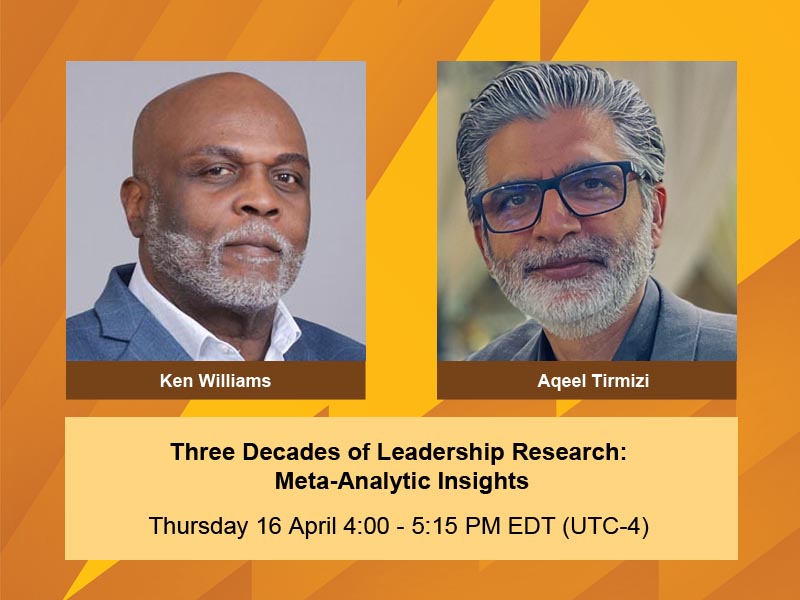
With Drs. Ken Williams, Aqeel Tirmizi and Kevin Lowe (Moderator)
Cost: Free.
This webinar is open to all attendees thanks to our sponsor Antioch University.
- 16 April 2026, 4 p.m. EDT (UTC-4)
Over the past thirty years, leadership studies have expanded considerably – spanning transformational, transactional, ethical, authentic, and servant leadership perspectives. Yet individual studies often produce mixed or context-specific findings. Meta-analysis provides a powerful solution by combining hundreds of studies and perspectives of thousands of respondents. By statistically integrating results across many independent studies, meta-analysis corrects for sampling error and measurement bias, estimates better understanding of effect sizes (strength of relationships between variables), and identifies patterns that are not visible in single studies. In short, it transforms scattered evidence into cumulative knowledge.
This webinar reviews three decades of meta-analytic research to identify and clarify what matters in leadership. It will examine which leadership approaches most strongly predict performance, engagement, well-being, and other outcomes of interest. These insights sharpen theory, guide evidence-based practice, and inform leadership development investments with greater precision and confidence. Participants will gain a clearer understanding of how meta-analytic findings inform debates, challenge assumptions, and support more robust understanding of leadership dynamics and effectiveness.
The session will focus on the following key questions:
- How meta-analysis strengthens evidence and resolves conflicting findings in leadership research.
- Which leadership approaches show the most robust, replicable effects across contexts.
- How to translate meta-analytic evidence into leadership development and effectiveness
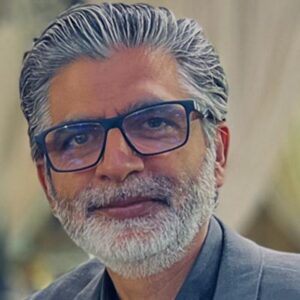
Dr. Aqeel Tirmizi is a Professor of Leadership and Organizational Behavior at Antioch University’s Department of Leadership and Change. His teaching, research, and consulting focus on leadership, organizational behavior and design, humanistic management, social innovation, as well as cross-cultural leadership. With three decades of international experience, Aqeel’s current work focuses on integrating research wisdom to meaningfully inform leadership and organizational practices and contribute to improving human condition. His publications have appeared in several peer-reviewed outlets. He regularly presents his work at national and international conferences.
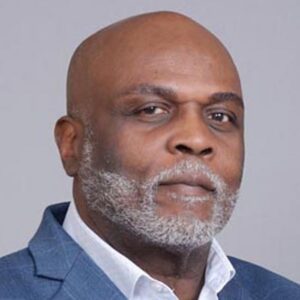
Dr. Ken Williams brings over 30 years of experience in higher education, having served as president, dean, associate dean, department head, and faculty member. His academic leadership focuses on organizational development, systems transformation, and cultivating institutional cultures grounded in equity, accountability, and high performance. His scholarship examines leadership as a relational and systemic process, emphasizing values-based, inclusive, and organizational behavior–oriented approaches. By connecting insights from multiple leadership frameworks, he explores patterns and principles that shape effective leadership at broader organizational and systemic levels, bridging theory and practice to strengthen institutions and inform contextually grounded leadership models.

Dr. Kevin B. Lowe is Professor in Leadership in the Business School at the University of Sydney and Chair of the Board of the International Leadership Association. A recognized leader in the field of leadership, Kevin research has garnered several awards including twice winning the Best Paper of the Year Award from The Leadership Quarterly. His serves on numerous boards for several leading academic associations. An enthusiastic teacher Kevin received the Board of Governors Teaching Excellence Award recognizing teaching excellence across the seventeen campus University of North Carolina system.