
by Dennis Tourish
- 12 November 2026
Share:
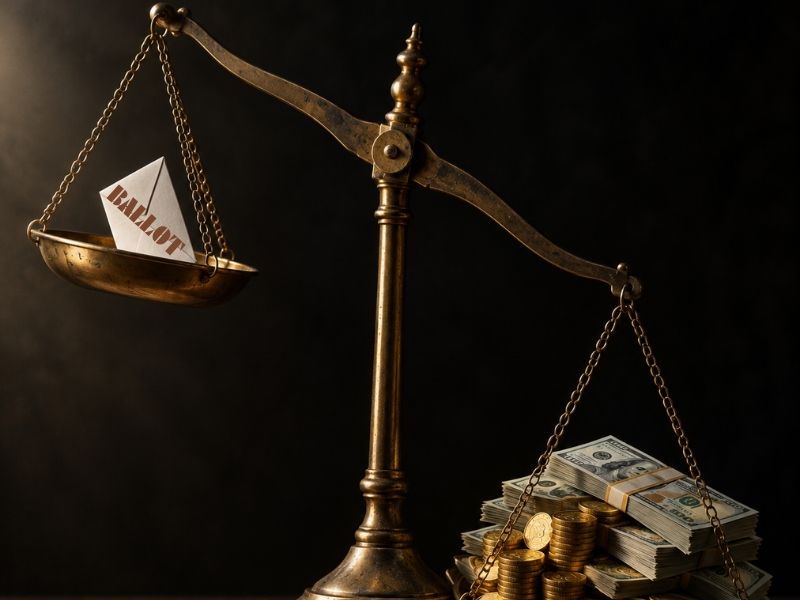
On election day, political leaders often tremble in fear of the people’s verdict. The vote of a billionaire has no more weight than that of a pauper. The recent midterm elections in the United States showed us that leaders who seem all powerful can still find themselves much diminished by the humble act of people exercising their hard won right to vote. But democracy means more than voting. In this blog, I consider how much of the political process has been captured by money, how this undermines democracy long before votes are cast, and what we can do about it.
Go back to the 2026 midterm U.S. elections. A record $11.87 billion was spent on political advertising, evenly split between the two main parties (AdImpact, 2026; Fountain, 2026). Where did this money come from? At least $2.7 billion was donated by those that The Washington Post describes as “the ultra-rich” (Ence Morse et al., 2026). $1.7 billion went to Republicans and $832 million to Democrats. This was 22.8% of the $11.87 billion total. Elon Musk donated $446 million. It was the largest amount ever contributed in an election by an individual who was not themselves running for office. $224 million of this was spent in Texas (Schleifer, 2026). It is true that Musk failed to get what he wanted. This doesn’t mean that there isn’t a problem. Those with money have a much greater opportunity to influence the outcome than those without. Elections can resemble a boxing contest in which one of the fighters has stuffed his gloves with horseshoes, even if all his punches don’t land. And it’s not just Republicans. Reliance on donations from the mega-wealthy has also skewed Democratic politics to favor their interests.
Consider too the 2024 Presidential election. This was one of the most expensive ever. Democrats spent about $6.7 billion and Republicans $7.6 billion (Grabenstein, 2024). Donations from 300 billionaires and their immediate family members made up 19% of this total. They contributed a relatively paltry 0.3% of political spending in 2008. What changed? In 2010 the U.S. Supreme Court ruled that there should be no limits on political donations. The influence of billionaires on politics has skyrocketed ever since (Baker & Rich, 2026). In 2026, Donald Trump’s cabinet in the U.S. had roughly a dozen billionaires in its ranks (Chazan, 2026; Zhang, 2026). The word that best describes such a state of affairs is corruption. As the political scientist Jeffrey Winters notes, “Pretending that private wealth is somehow not raw political power is the grand lie that sustains domination through democracy” (Winters, 2026, p. 26). It all calls to mind the old saying that an honest politician is someone who, when they are bought, stays bought.
This is not a purely American problem. In August 2025 the little-known Christopher Harborne donated a massive £9 million to the Reform party in the UK, led by the populist leader Nigel Farage. In November of the same year, he gave a further £3 million. It also emerged that he had given Farage a personal gift of £5 million. Harborne made most of his money through cryptocurrency. For someone bankrolling a nationalist party, it is ironic that he spent the previous 25 years living in Thailand, where he goes under the name Chakrit Sakunkrit (Thomas, 2026). In late 2026 the crypto billionaire Ben Delo, convicted in the U.S. for failing to implement money laundering controls, donated a staggering £36 million to Reform, which Harborne promptly matched. They were the two largest donations to a political party in the country’s history (Mason, 2026). It is, of course, a coincidence that Farage has proposed that the UK should become a major hub for crypto currency, with capital gains tax on crypto reduced from 24% to 10%.
Some would like to strengthen the power of wealth in politics still further. One suggestion, endorsed by Tobias Lütke, the billionaire cofounder and CEO of Shopify, is that voting rights should be tied to how much tax people pay. Specifically, the proposal he endorsed argued that there should be “zero votes for anyone who pays no income tax, one vote for those earning $1–100K, two votes for $100–200K, scaling up in that pattern to a hard cap of five votes for anyone earning $500K or more.” This was pitched as fairness, since it would give more representation to those who pay the bills through taxation. As Fortune magazine’s analysis noted, those deprived of the franchise would include “all retirees living on Social Security and pension income, students, caregivers, disabled Americans, and millions of low-wage workers who owe no net federal income tax after deductions and credits” (Lichtenberg, 2026). That the right to vote was historically associated with owning property and wealth does little to enhance the attractiveness of such ideas today.
Pretending that private wealth is somehow not raw political power is the grand lie that sustains domination through democracy. - Jeffrey Winters
What Can Be Done?
In my view, the only solution is to move toward the public financing of electoral campaigns and politics generally. In the aftermath of the U.S. midterms, the state of Montana voted to stop corporations, trade associations, labor unions, and nonprofits from spending money to influence elections in the state. 65% of voters were in favor and only 34% against, with the law scheduled to take effect on January 1, 2027 (Drew et al., 2026). Around 30 other states are considering similar measures. But while the Montana measure would prevent corporate spending on elections, it would not prevent billionaires from splashing out with their own personal wealth.
One proposal that has been made is that citizens of voting age should be given a special kind of debit card each year. This could only be used for electoral campaigns. Political parties that accept such donations would be banned from receiving money from any other source (Ackerman & Ayres, 2002). I think this could be strengthened by compelling political parties to rely entirely on some form of public funding. This would limit the power currently wielded by wealthy oligarchs and help to equalize our participation in politics. Such is the low opinion most people have of politics that such measures are unlikely to be popular. But the alternative is a system where the rich buy political influence, which they then use to serve their own interests.
From Political Office to the Boardroom
A related issue is the tight relationships formed between politicians in office and those with extreme wealth. These have been further exposed through the Jeffrey Epstein scandal. Epstein, a paragon of avarice, corruption, and lust, worked alongside his coterie of enablers to inflict horrific sexual abuse on countless young women and girls. In addition, the release of what has become known as the “Epstein files” revealed his links with numerous politicians. Britain’s Peter Mandelson was among them and was fired as the country’s ambassador to the U.S. as a result. Mandelson was business secretary and Alastair Darling was Chancellor of the Exchequer in the UK when the Great Recession brought the world economy to the brink in 2008. The Government was considering a one-off tax on bankers’ bonuses. A few days before the tax was announced Epstein wrote as follows to Mandelson, “any real chance of making the tax only on the cash portion of the bankers’ bonus.” Mandelson responded almost immediately: “Trying hard to amend as I explained to Jes last night. Treasury digging in but I am on case.” Shortly afterwards, Epstein wrote, “should jamie call darling one more time?” This refers to Jamie Dimon, the then CEO of J.P. Morgan. Mandelson replied, “yes and mildly threaten” (Cassidy, 2026). A government minister was advising a wealthy hedge fund manager on how to stymie a key policy of his own government. One of Peter Mandelson’s preoccupations in these communications was an attempt to lever himself into a role at J.P. Morgan in the future. Favors and information were traded to that end.
This example shows the urgent need to close the revolving door between politics and business, whereby senior politicians step seamlessly and shamelessly from public office and into the boardrooms of major companies. A mandatory, lengthy gap between the two would reduce the opportunities for corruption. Thebes is a Greek city that in ancient times rivaled Sparta and Athens. Aristotle noted approvingly in his book The Politics that it had “a law requiring an interval of ten years to elapse between giving up trade and participating in office” (Aristotle, ca. 350 B.C.E./1962, p. 185). I see no good reason why we shouldn’t do the same today.
Democracy is not a commodity to be bought and sold like shares in the marketplace, and political leaders should not be mercenaries who sell their souls to the highest bidder. It is little wonder that faith in the political process is often so low. Cleansing politics of money’s outsized influence can help to ensure that equal participation goes beyond election day, and that political leaders serve the common good rather than the interests of those with the deepest pockets.
Ackerman, B., & Ayres, I. (2002). Voting with dollars: A new paradigm for campaign finance. Yale University Press.
AdImpact. (2026, November 3). Election Day insights center: 2026 midterms. https://adimpact.com/election-day-midterms-26
Aristotle. (1962). The politics (T. A. Sinclair, Trans.). Penguin Classics. (Original work published ca. 350 B.C.E.)
Baker, M., & Rich, S. (2026, March 9). The scale of billionaires’ campaign donations is overwhelming U.S. politics. The New York Times. https://www.nytimes.com/2026/03/09/us/billionaires-federal-election-campaign-contributions.html
Cassidy, J. (2026, February 16). The Jeffrey Epstein files are Peter Mandelson’s final disgrace. The New Yorker. https://www.newyorker.com/news/the-financial-page/the-jeffrey-epstein-files-are-peter-mandelsons-final-disgrace
Chazan, G. (2026, August 7). America’s new oligarchy. Financial Times. https://www.ft.com/content/2472ef5a-798d-4e7b-b4be-020855cf387e
Drew, M., Szpaller, K., & Hansen, J. (2026, November 4). Montanans overwhelmingly approve 3 ballot measures. Daily Montanan. https://dailymontanan.com/2026/11/04/montanans-overwhelmingly-approve-3-ballot-measures/
Ence Morse, C., Shapiro, L., Somasundaram, P., & Lau, E. (2026, June 25). Musk breaks donor record as the ultrarich pour $2.7 billion into the midterms. The Washington Post. https://www.washingtonpost.com/elections/interactive/2026/06/25/these-are-biggest-individual-donors-2026-election-cycle/
Fountain, L. (2026, November 6). Montana votes to ban corporate political money. Next stop? Probably the Supreme Court. CNBC. https://www.cnbc.com/2026/11/06/montana-initiative-194-corporate-spending.html
Grabenstein, H. (2024, November 6). The cost of this election. PBS NewsHour. https://www.pbs.org/newshour/live-update/election-news-2024/the-cost-of-this-election
Lichtenberg, N. (2026, July 27). Why did a $154 billion CEO just endorse stripping most Americans of voting rights—and taking us back to the 19th century? Fortune. https://fortune.com/2026/07/27/shopify-ceo-voting-rights-stripping-americans-19th-century/
Mason, R. (2026, September 12). Reform UK given record £36m donation by British crypto billionaire. The Guardian. https://www.theguardian.com/politics/2026/sep/11/reform-uk-given-record-36m-donation-by-british-crypto-billionaire
Schleifer, T. (2026, November 2). Elon Musk tests what nearly half a billion dollars can buy in the midterms. The New York Times. https://www.nytimes.com/2026/11/02/us/politics/elon-musk-midterm-spending.html
Thomas, C. (2026, March 1). The invisible man whose millions are transforming British politics. The Observer. https://observer.co.uk/news/politics/article/the-invisible-man-whose-millions-are-transforming-british-politics
Winters, J. (2026). The blind spot: How oligarchs dominate our democracy. Scribner.
Zhang, S. (2026, January 7). Top 15 US billionaires gained nearly $1 trillion in wealth in Trump’s first year. Truthout. https://truthout.org/articles/top-15-us-billionaires-gained-nearly-1-trillion-in-wealth-in-trumps-first-year/
About Professor Dennis Tourish

Dennis Tourish is Emeritus Professor of Leadership and Organization Studies at the University of Sussex Business School. His latest book is due in 2027 and is entitled Selling Salvation: Why We Follow Leaders Who Promise Utopia and Deliver Disaster. He is the author several other books, including Management Studies in Crisis: Fraud, Deception and Meaningless Research (Cambridge University Press, 2019), and The Dark Side of Transformational Leadership (Routledge, 2013). Dennis is a former editor of the journal Leadership. One of his key interests is in organizations that can be described as cults, and he has been interviewed frequently about this on TV and radio. Dennis is a 2026 recipient of ILA’s Lifetime Achievement Award and is an ILA Fellow.